
Desire Hydraulics manufactures C frame hydraulic presses in-house at MIDC Bhosari, Pune, for automotive, sheet-metal, engineering and general industrial customers across India. The open-front frame gives easy access from the front and sides for punching, bending, straightening, assembly, riveting and embossing. Each press is sized to your tonnage, stroke, daylight and bed size, and tested under load before dispatch.
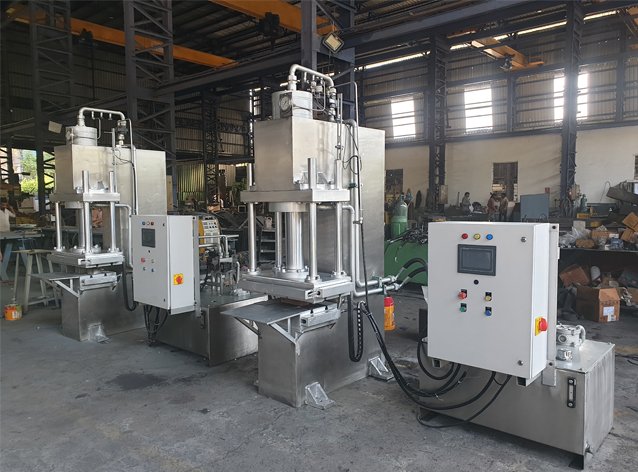
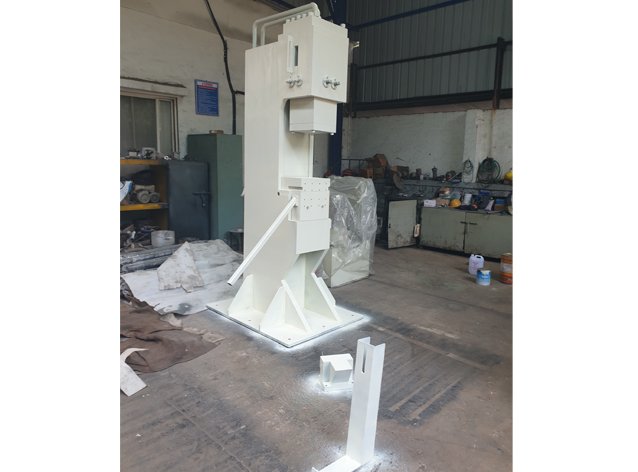
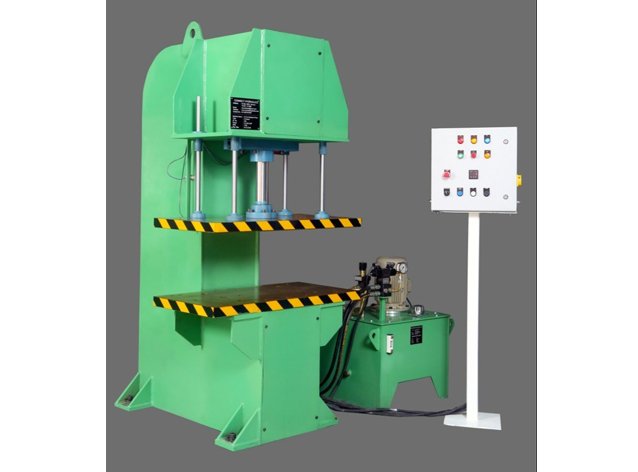
C-frame hydraulic presses built at our Pune works. See more machines in the gallery.
A C frame hydraulic press is built around a C-shaped frame, and that open front is the whole point. Operators can load, position, inspect and remove parts from the front and sides, which is why the design is a workhorse for punching, bending, forming, straightening and assembly.
Choosing one on tonnage or price alone is how people end up with a press that does not fit the job. The right machine has to match your operation, tooling, material, cycle, working area, stroke and daylight, and it is easier to get that right when the manufacturer builds the frame, cylinder, power pack and controls under one roof.
Why buyers choose Desire Hydraulics for C frame presses
- Application engineering first. We start with your operation, material and component, not a catalogue tonnage number.
- In-house from steel to dispatch. Frame fabrication, machining, assembly and testing all happen at MIDC Bhosari, Pune.
- Tested, not assumed. Hydraulic cylinders and power packs are run and checked under load before the machine ships.
- Own hydraulics. We also build power packs and cylinders, so the core of your press is engineered by the same team as the frame.
- Support after delivery. Installation guidance and after-sales service across Pune, Maharashtra and India.
- Proven volume. 5,000+ hydraulic machines delivered to customers in India and the UAE.
See the wider hydraulic press range, the H frame press guide and our guide to hydraulic press manufacturers in India.
What is a C frame hydraulic press?
It is an industrial press with a C-shaped steel frame, a hydraulic cylinder and ram, a table or bed, a power pack and a control system. Hydraulic pressure acting on the cylinder produces the force. Unlike a closed frame, the C-frame gives an open working envelope, which helps with individual components, fixtures, dies and assembly work where access is part of the process.
In short: an open C-shaped frame, a sized cylinder and ram, and a bed built to your tooling give you a press for punching, bending, straightening, forming, assembly, riveting or embossing, with easy access to the work.
Operations a C frame hydraulic press can perform
Often more than one, with the right tooling.
- Punching: force sized to material shear strength, thickness and cutting perimeter, with die and fixture-based tooling.
- Bending: capacity set by material, thickness, bend length and tooling. The open frame simplifies positioning.
- Straightening: correcting parts after machining, welding or handling. The fixture and locating arrangement are as important as the press.
- Assembly: bush insertion, bearing work, pin insertion and shaft fitting, with sensors, stroke or pressure control on request.
- Riveting: fixture-based positioning and repeatable cycle force, with open-front access to the tooling.
- Embossing and forming: within the machine's designed force, stroke and tooling range.
- Drawing: sized to component depth, material and force through the tooling.
- Moulding and pressing: built around temperature, tooling, cycle time and force for the process.
Typical C frame hydraulic press specification range
No single spec sheet is right for every customer. These are the parameters we set with you, and exact figures are confirmed against your application.
| Parameter | How it is decided |
|---|---|
| Tonnage | Custom-built to the process, sized to the actual job, not the largest available machine. |
| Stroke | Calculated from the component, die height, loading method and complete operating cycle. |
| Daylight | Sized to the tooling, dies, fixtures and component arrangement. |
| Table or bed size | Holds the component, die and fixtures, with room for future tooling. |
| Power pack | Pump, reservoir, valves, pressure controls, filters, piping and pressure measurement, sized to the press. |
| Controls | Manual, electrical, semi-automatic or PLC and HMI, depending on the repeatability you need. |
| Ram speed | Approach, pressing and return speeds set to the application and cycle time. |
| Construction and testing | Fabricated steel C-frame, in-house machining and assembly, tested under load before dispatch. |
Looking for an exact tonnage, stroke, daylight or table size? Share your component drawing, material and operation and we will size the press against it.
How to choose the right C frame hydraulic press
Begin with the component and the process, not a catalogue. This is the sequence we work through with every customer.
- Define the operation: punching, bending, straightening, forming, press fitting, assembly, riveting, embossing, drawing or moulding.
- Understand the material: type, thickness, component dimensions, shape, strength where relevant, quantity and cycle.
- Work out the force: calculate it from the process. Punching force depends on shear strength, thickness and cutting perimeter, while forming and bending depend on the process and tooling.
- Set the stroke: enough for the full movement without unnecessary travel.
- Set the bed size: it must hold the tool, fixture and component, and ideally variants you may need later.
- Set the daylight: a powerful press with too little daylight is still the wrong press.
- Choose the operating method: manual, semi-automatic, automatic or PLC-controlled, based on labour, repeatability and cost.
- Consider volume: occasional maintenance work and continuous production have different priorities for cycle time, controls, safety and maintainability.
Main components of a C frame hydraulic press
Performance depends on how these parts work together, not on the frame and cylinder alone.
- C-shaped structural frame
- Hydraulic ram and cylinder
- Power pack with pump, motor, reservoir and filters
- Pressure control valves
- Table or bed, and the tooling or die interface
- Control panel, with PLC and HMI on request
- Safety guarding, interlocks, two-hand controls and emergency stop
C frame vs H frame vs four-column
| Frame | Strengths | Choose it when |
|---|---|---|
| C frame | Open front, quick loading, compact footprint | You do lighter pressing, punching, bending, assembly or riveting at a workstation. |
| H frame | Stiff frame, open sides for long parts | You do straightening, heavier pressing and forming on large parts. |
| Four-column | Even load over a large bed, guided moving platen | You run die-based work such as deep drawing, forming or compression moulding. |
Related reading: H frame and 4 column hydraulic press manufacturer in Pune.
Where C frame presses are used
- Automotive and auto-ancillary: component pressing, bush insertion, assembly, straightening, forming and punching.
- Sheet metal fabrication: punching, forming, bending and embossing, sized to material, thickness and part geometry.
- Bush and bearing assembly: press fitting with controlled hydraulic force.
- Electrical and switchgear: component pressing and assembly for panel and switchgear parts.
- General engineering and job work: punching, forming, straightening and assembly across varied components.
- Structural and fabrication units: riveting, embossing and pressing.
C frame hydraulic press manufacturer in Pune and across India
We are based at MIDC Bhosari, in the middle of Pune's industrial belt that includes Pimpri-Chinchwad, Chikhali, Chakan and Talegaon. That makes site visits, fixture trials and service simple for customers here. Outside Pune the process is the same: drawings and a call, a written specification, manufacture and testing at our works, dispatch, then installation and commissioning at your site.
- Nashik and Aurangabad (Chhatrapati Sambhajinagar): engineering, auto-component and sheet-metal units.
- Ahmedabad and Gujarat: fabrication, metal forming and general engineering units.
- Coimbatore and Tamil Nadu: machinery, foundry and general engineering users.
- Kerala: fabrication, rubber and engineering units, where we confirm delivery and commissioning scope in the quotation.
- Other states, and the UAE: quoted the same way, based on your application, force, stroke and daylight.
What to ask a C frame hydraulic press manufacturer
A supplier may simply hand over whatever machine is available. A manufacturer who engineers the press around your job is a different conversation. Ask:
- Do you understand my operation, material and component before quoting?
- Can the press be configured around my component, or only offered in a fixed size?
- Can you justify the tonnage from my process?
- Can you provide the stroke and daylight my tooling needs?
- What pump, valves, power pack and pressure arrangement are you proposing?
- What controls and safety features are included: guarding, two-hand controls, emergency stop?
- Is tooling included, and what installation and commissioning support is offered?
- What documentation, maintenance guidance and after-sales service will I get?
What decides C frame hydraulic press price
Tonnage, stroke, table size, daylight, cylinder, power pack, controls and automation, tooling, safety systems, customisation, transport and installation all move the price. Two presses of the same tonnage can be very different machines, so compare specification, application fit and support together, and ask for a technical quotation prepared after your requirement is understood. To get one, send the application, material, component dimensions, required force if known, stroke, table size, daylight, production quantity, tooling details and automation needs. Use the enquiry form or call +91 75585 54709.
C frame hydraulic press: frequently asked questions
What is a C Frame Hydraulic Press?
A C Frame Hydraulic Press is a hydraulic pressing machine built around an open C-shaped frame. Its open working area provides convenient access for loading, unloading, tooling and various industrial pressing operations.
What is a C Frame Hydraulic Press used for?
Depending on its configuration and tooling, a C-frame hydraulic press can be used for punching, bending, straightening, pressing, forming, assembly, riveting, embossing, drawing, moulding and other industrial applications.
Who is a leading C frame hydraulic press manufacturer in Pune?
Desire Hydraulics is a C frame hydraulic press manufacturer at MIDC Bhosari, Pune, Maharashtra. Frames, cylinders, power packs and control panels are built and tested in-house, and the company has delivered 5,000+ hydraulic machines across India and the UAE.
How do I select the right C Frame Hydraulic Press?
Start with the application. Identify the material, component dimensions, required force, stroke, table size, daylight, tooling and production cycle. These parameters can then be used to determine the appropriate press configuration.
What tonnage C Frame Hydraulic Press do I need?
The required tonnage depends on the operation, material, component geometry, tooling and process. It should be calculated from the actual application rather than selected only from a standard machine range.
Can a C Frame Hydraulic Press be customized?
Yes, hydraulic presses can be configured around application-specific requirements such as tonnage, stroke, table size, daylight, hydraulic system, controls, automation and tooling arrangements.
Can C Frame Hydraulic Press machines be used for punching?
Yes, C-frame hydraulic presses can be configured for punching applications when the machine capacity, tooling and hydraulic system are appropriate for the required operation.
Can a C Frame Hydraulic Press be used for bending and straightening?
Yes. A suitably configured C-frame hydraulic press can be used for certain bending operations, with the required force depending on material, thickness, bend length and tooling. Straightening is another common application, selected according to the component, material and required correction force.
What is the difference between a C Frame and H Frame Hydraulic Press?
A C-frame press has an open front that makes loading easy and suits lighter pressing, punching, bending and assembly. An H-frame press has a stiffer frame with open sides and is usually chosen for heavier and larger work such as straightening and forming. The right choice comes from your application, force, tooling and working area.
What is the difference between C Frame and 4 Column Hydraulic Press?
A C-frame press has an open C-shaped frame with easy access from the front and sides. A four-column press guides the moving platen on four columns and spreads load evenly over a large bed, which suits die-based work such as deep drawing and compression moulding.
How much does a C Frame Hydraulic Press cost?
The price depends on tonnage, stroke, table dimensions, hydraulic system, controls, automation, tooling and other application-specific requirements. A reliable price quotation should be prepared after understanding the technical requirement.
Can I get a C Frame Hydraulic Press from a manufacturer in Pune?
Yes. Pune has an established market for hydraulic and industrial machinery, including C-frame hydraulic press machines. When choosing a manufacturer, compare technical capability, machine configuration, application understanding, support and overall suitability rather than price alone.
What information is required for a C Frame Hydraulic Press quotation?
The most useful information includes the application, material, component dimensions, required force, stroke, table size, daylight, production quantity, tooling details and automation requirements.
Does Desire Hydraulics supply C frame hydraulic presses to Nashik, Aurangabad, Ahmedabad, Coimbatore and Kerala?
Yes. Desire Hydraulics quotes and supplies C frame presses across Maharashtra and to other Indian states, and also supplies the UAE. Transport, installation and commissioning are confirmed in the quotation.
What maintenance does a C frame hydraulic press need?
Check oil level and temperature, change filters on schedule, inspect hoses, fittings and cylinder seals for leaks, and confirm pressure settings, electrical connections and guarding. Follow the schedule supplied with the machine.