
Desire Hydraulics is a hydraulic press manufacturer at MIDC Bhosari, Pune. It designs, machines and pressure-tests C-frame, H-frame, four-column, deep drawing and custom presses in-house, and supplies them across India and to the UAE. When you compare manufacturers, judge each one on how well the press matches your component: tonnage, stroke, daylight, bed size and controls. Tonnage on a catalogue is not enough.
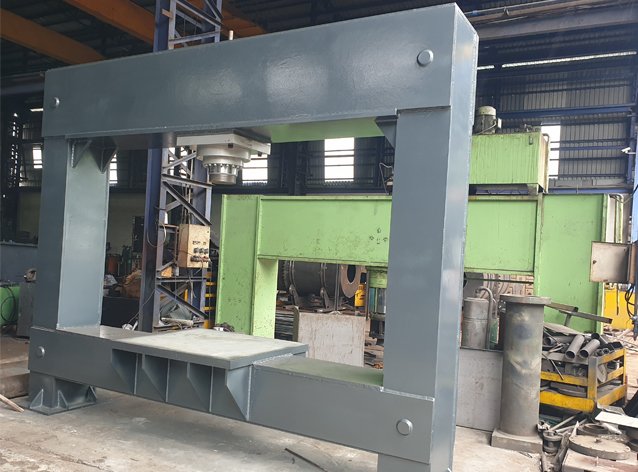
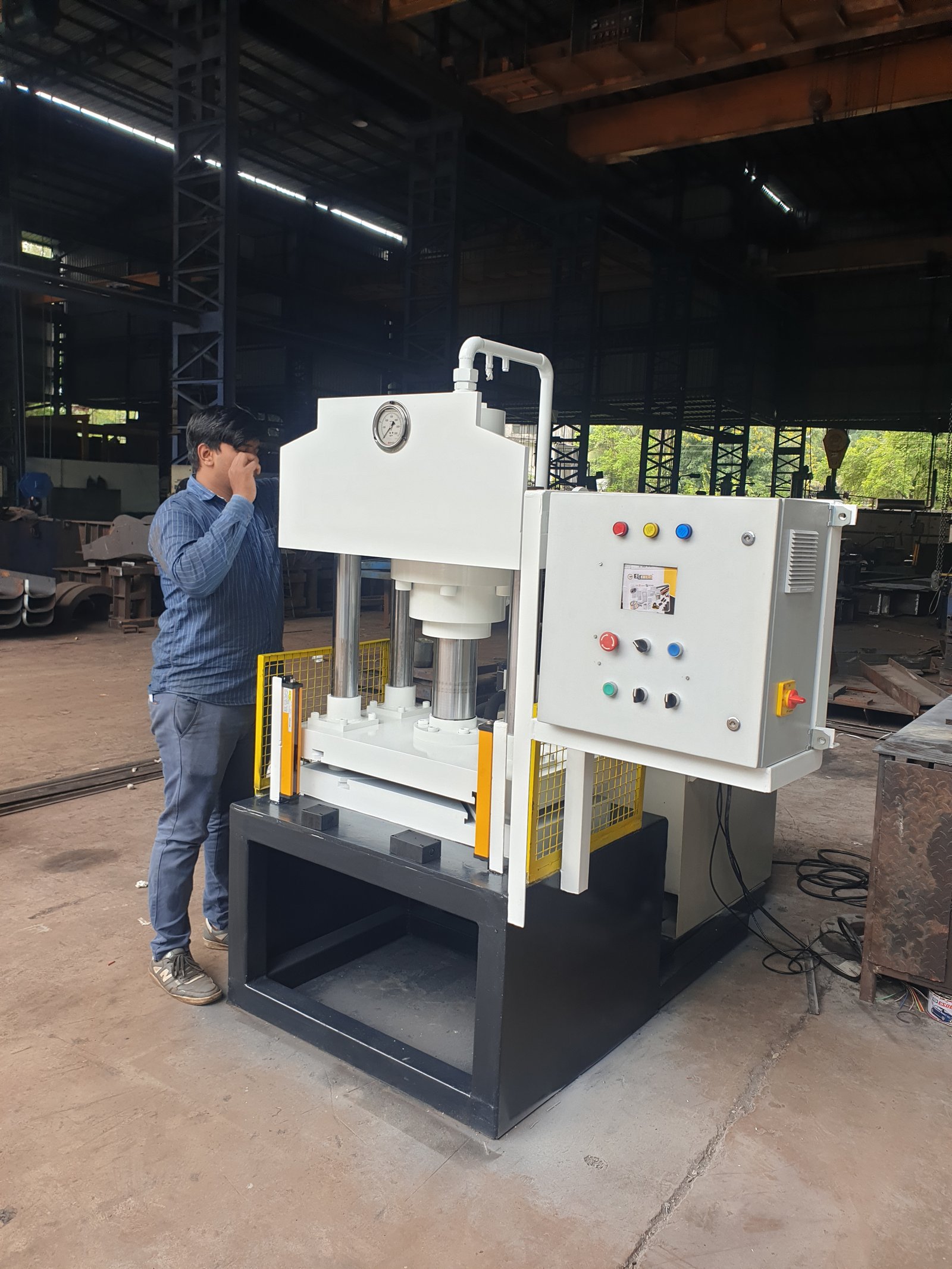
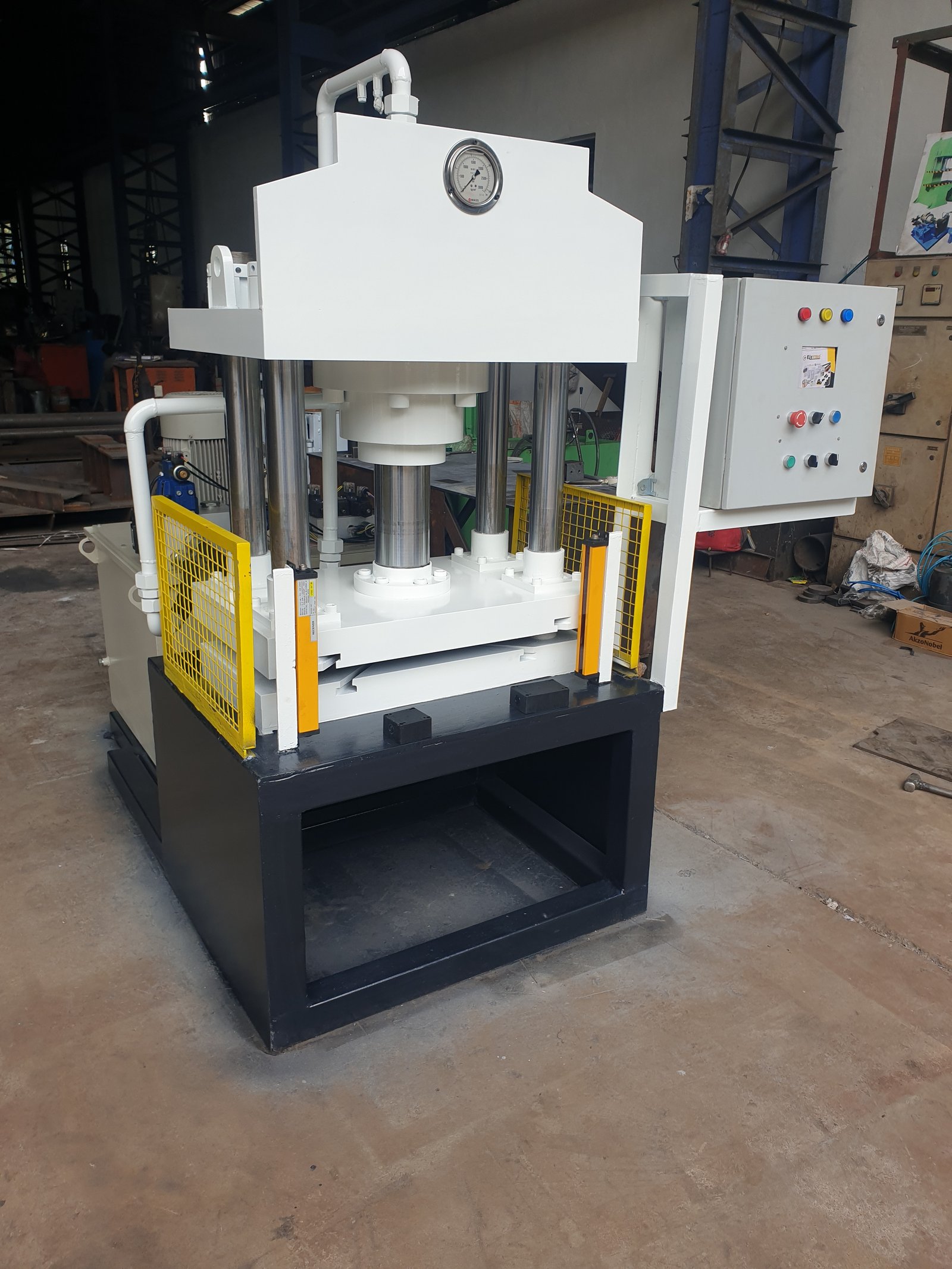
Hydraulic presses built at our Pune works. See more machines in the gallery.
A hydraulic press turns oil pressure into controlled force through a cylinder. That part is textbook. What separates one manufacturer from another is everything around it: the frame that has to carry that force cycle after cycle, the power pack that sets how fast the ram moves, the valves and controls that make each stroke repeatable, and the guiding that keeps your die aligned.
Most problems with a badly specified press have little to do with tonnage. The bed is too small for the fixture, there is not enough daylight to load the part, the ram is too slow for the cycle time, or the frame flexes under off-centre load. This guide covers how to avoid those, and how to compare hydraulic press manufacturers in India on things that matter.
Why buyers choose Desire Hydraulics
We would rather give you facts you can check than adjectives. This is what a buyer gets when a press comes from us:
- Design to dispatch under one roof. Frames, machining, hydraulics and assembly happen at our facility in MIDC Bhosari, Pune, so accountability sits with one team.
- Pressure-tested before it ships. Every press is tested in-house before dispatch.
- Specified around your component. Tonnage, bed size, stroke and automation are matched to the part you make, not picked from a fixed catalogue.
- The whole hydraulic system from one maker. We also build hydraulic power packs, cylinders, balers and GDC machines, so the pack and cylinder in your press are not bought-in unknowns.
- Track record. 5,000+ orders delivered across our machine range, supplied across India and to the UAE.
See the full range on our hydraulic press machine page.
Types of hydraulic press and where each fits
| Type | Typical work | What to check |
|---|---|---|
| C-frame (gap frame) | Punching, light pressing, bending, straightening, bush and bearing fitting, riveting | Open front makes loading easy, but the frame is less rigid than a closed frame, so check deflection on heavy or precision work. |
| H-frame | Heavy pressing, straightening of long shafts and fabrications, forming, maintenance work | Stiff and forgiving on large parts. Confirm bed width and daylight against your fixture. |
| Four-column | Deep drawing, sheet-metal forming, compression moulding, larger dies | Even load over a bigger bed with good guiding. Columns limit side access, so plan how the die is loaded. |
| Deep drawing press | Drawn shells and cylindrical parts | Needs controlled ram speed and a blank-holding or cushion arrangement, not just tonnage. |
| Custom press | Special tonnage, tall daylight, ejectors, shuttle tables, PLC or HMI sequences | Worth it only where the change solves a real process problem. |
How to choose the right hydraulic press
Start with force, then add margin
Force equals pressure multiplied by piston area. At 200 bar, a cylinder with a 250 mm bore delivers roughly 100 tonnes. Work backwards from your process: punching force is about the cut perimeter times material thickness times shear strength, while forming, drawing and straightening each need their own estimate. Then allow a working margin, so the press is not run at its limit on every stroke. Oversizing wastes money and power; undersizing stops production.
Then check the rest of the specification
- Stroke: enough travel for the tool to close and for the part to be loaded and removed.
- Daylight: the open height between working surfaces must clear the die and the component.
- Bed size and working height: the fixture must fit, and the operator must be able to reach and handle the part comfortably.
- Ram speed and cycle time: a pump sized for the tonnage may still be too slow for your output. Ask for approach, pressing and return speeds.
- Controls: conventional valve control is fine for occasional pressing. Repeatable production sequences justify PLC and HMI control.
- Safety: guarding, two-hand control where needed, and a set relief valve are not optional extras.
Where hydraulic presses are used
- Automotive and auto components: press-fitting bushes and bearings, straightening, forming and punching. Pune, Chakan and Ranjangaon make this a major user base.
- Sheet metal and fabrication: bending, forming, embossing, drawing and straightening, where material and thickness drive the choice.
- Foundries and die casting: die spotting, trimming and pressing work alongside casting machines.
- Rubber and composites: compression moulding needs steady force, heated platens and a suitable mould interface.
- Maintenance and repair shops: general-purpose pressing and straightening where flexibility matters more than speed.
Hydraulic press manufacturer for every part of India
We are based in Pune, but few press purchases are walk-in anymore. The usual path is drawings and a call, a written specification, manufacture and testing at our works, dispatch, then installation and commissioning at your site. That process works the same for Nashik as for Kerala.
Pune, Pimpri-Chinchwad, Bhosari, Chakan, Talegaon and Ranjangaon
Our home market. You can visit the works at MIDC Bhosari and go through the specification with the engineers in person.
Nashik
A well-established engineering and auto-component cluster, a few hours by road from Pune. Typical needs are pressing, straightening, forming and fabrication work.
Chhatrapati Sambhajinagar (Aurangabad)
Industrial areas such as Waluj and Chikalthana use presses for component production, assembly and forming. We supply and quote for the region.
Ahmedabad and Gujarat
A large base of engineering, fabrication and metal-processing units in and around Ahmedabad's GIDC estates. We quote against your drawing and ship to site.
Coimbatore and Tamil Nadu
Pump, machinery, foundry and general engineering users need presses for assembly, forming and straightening. Requirements are handled through drawings, calls and site coordination.
Kerala
Fabrication, rubber and general engineering units. With longer transport routes, we confirm delivery, installation and commissioning scope in the quotation.
Elsewhere in India and the UAE
Karnataka, Telangana, Delhi NCR, Haryana, Punjab, Uttar Pradesh, West Bengal, Odisha and other states are quoted the same way. We also supply customers in the UAE.
How to compare hydraulic press manufacturers
Send the same specification to every manufacturer on your shortlist, then compare their answers to these:
- Do they ask about your component and process before quoting?
- Is the press built in-house, or assembled from bought-in parts?
- What are the frame construction, cylinder and power pack details?
- How is the finished press tested before it leaves?
- What controls are included, and can PLC or HMI be added?
- Who handles installation, commissioning and operator guidance?
- What about spare parts, breakdown support and warranty terms?
- Are manuals and technical documents supplied?
What decides hydraulic press price in India
Any listing that shows one price for "a hydraulic press" is hiding the specification. Cost moves with tonnage, frame type, stroke, bed size, daylight, cylinder and power pack quality, controls and automation, tooling interface, safety systems, customisation, transport and installation.
That is why two quotations for the same tonnage can be far apart. Compare price together with specification, application fit and support, not price alone. We give a technical quotation instead of a generic rate.
What to send for a quotation
You do not need every number. Send what you have:
- The operation: pressing, punching, bending, straightening, drawing or moulding
- Material and thickness
- Component dimensions, with a drawing or photograph if possible
- Required force, if known
- Stroke, bed size and tooling or die details
- Production quantity and automation needs
- Delivery location
Use the enquiry form or call +91 75585 54709. Our engineers will come back with a recommended configuration.
Hydraulic press manufacturers in India: frequently asked questions
Who are the top hydraulic press manufacturers in India?
Hydraulic press manufacturers are concentrated in Pune, Nashik, Ahmedabad, Rajkot, Coimbatore, Bengaluru, Delhi NCR and Ludhiana. There is no independent ranking, so shortlist by in-house manufacturing, build quality, testing before dispatch, customisation and after-sales support. Desire Hydraulics in Pune belongs on that shortlist: presses are designed, machined and pressure-tested in-house, and 5,000+ orders have been delivered across India and the UAE.
Which is the best hydraulic press manufacturer in India?
The best manufacturer is the one whose press fits your component, tonnage, stroke, daylight and production cycle, and who stands behind it after dispatch. Ask each shortlisted maker to quote against the same specification and compare frame construction, hydraulics, controls, testing and service, not just the price.
Who is a reliable hydraulic press manufacturer in Pune?
Desire Hydraulics is a hydraulic press machine manufacturer at MIDC Bhosari, Pune, Maharashtra. It builds C-frame, H-frame, four-column, deep drawing and customised presses, along with power packs, cylinders, balers and GDC machines.
What types of hydraulic press are available?
The common types are the C-frame (gap-frame) press, H-frame press, four-column (four-pillar) press, deep drawing press and customised presses built around a specific process. Each suits different work, so the type should follow the application.
What is the difference between a C-frame, H-frame and four-column hydraulic press?
A C-frame press has an open front for easy loading and suits punching, light pressing, bending and assembly. An H-frame press is stiffer and suits heavier pressing, straightening and fabrication work. A four-column press spreads load evenly over a larger bed with good ram guiding, which suits deep drawing, forming and compression moulding.
What is a hydraulic press used for?
Pressing, punching, bending, straightening, press-fit assembly, riveting, forming, deep drawing and compression moulding, depending on the machine and tooling.
How do I calculate the tonnage of a hydraulic press?
Press force equals hydraulic pressure multiplied by piston area, but the tonnage you need comes from your process. Punching force is roughly the cut perimeter multiplied by material thickness and shear strength. Forming, drawing and straightening each have their own calculation. Add a working margin so the press does not run at its limit on every stroke.
How much does a hydraulic press cost in India?
There is no single price. Cost depends on tonnage, frame type, stroke, bed size, daylight, power pack, controls, automation, tooling interface, installation and transport. Two presses of the same tonnage can differ widely in specification, so compare written quotations line by line.
Is a hydraulic press better than a mechanical press?
Neither is better everywhere. A hydraulic press delivers full force at any point in the stroke, with adjustable stroke and force and built-in overload protection through the relief valve. Mechanical presses are typically faster on high-volume blanking. Deep drawing, forming, straightening and moulding usually favour hydraulics.
Can Desire Hydraulics build a customised hydraulic press?
Yes. Presses can be built to a specific tonnage, stroke, bed size, daylight, working height, ejector arrangement, PLC or HMI control and safety requirement. Send your component drawing, photographs and process details so the engineers can specify it properly.
Does Desire Hydraulics supply to Nashik, Chhatrapati Sambhajinagar, Ahmedabad, Coimbatore and Kerala?
Yes. Desire Hydraulics quotes and supplies presses across Maharashtra and to other Indian states. Transport, installation and commissioning arrangements depend on the machine and the site, and are confirmed in the quotation.
Does Desire Hydraulics export hydraulic presses?
Yes. Desire Hydraulics supplies customers in India and the UAE, and can discuss other export markets subject to machine specification and project scope.
What information should I send to get a hydraulic press quotation?
The operation, material and thickness, component dimensions, force if known, required stroke, bed size, tooling or die details, production quantity, automation needs and delivery location. A drawing or photograph is often enough to start.
How do I compare hydraulic press manufacturers?
Compare like with like: frame construction, cylinder and power pack, valves and controls, how the press is tested before dispatch, customisation ability, installation and commissioning support, spare parts availability and warranty terms.
How long does delivery take?
It depends on tonnage, size and how much is customised. The lead time is stated in the quotation, so confirm it before ordering.
What maintenance does a hydraulic press need?
Keep the oil clean and at the right level, change filters on schedule, watch for leaks and unusual noise, check oil temperature, and keep pressure settings and guarding as set at commissioning. Follow the maintenance schedule supplied with the machine.