Desire Hydraulics is a Hydraulic Press Machine Manufacturer designing and building Four Column Hydraulic Press Machines, H-Frame Hydraulic Press Machines, C-Frame Hydraulic Press Machines, Hydraulic Workshop Press Machines, Hydraulic Straightening Press Machines, Hydraulic Deep Drawing Press Machines, Hydraulic Punching Press Machines, Hydraulic Baling Press Machines, Hydraulic Forging Press Machines, Hydraulic Rubber Moulding Press Machines and Special Customized Hydraulic Press Machines in-house at MIDC Bhosari, Pune — sized to your tonnage, working area, stroke and daylight requirement, and tested before dispatch to manufacturers across Pune, Nashik, Aurangabad, Gujarat, Bangalore, Kerala, Maharashtra, India and the UAE.
Actual Four Column, H-Frame and Workshop Hydraulic Press Machines engineered, assembled and tested at our MIDC Bhosari facility — click any photo to view it larger.
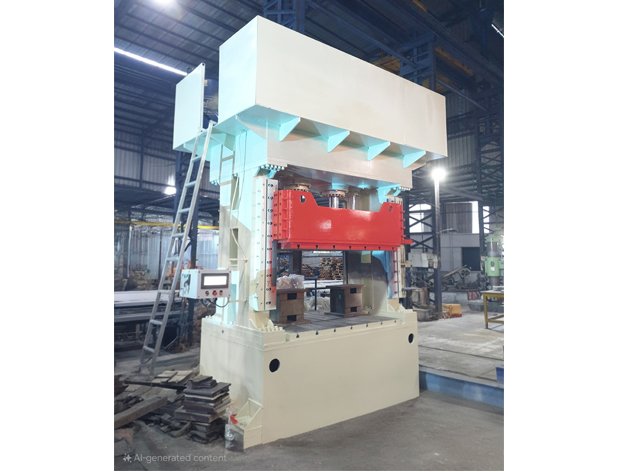
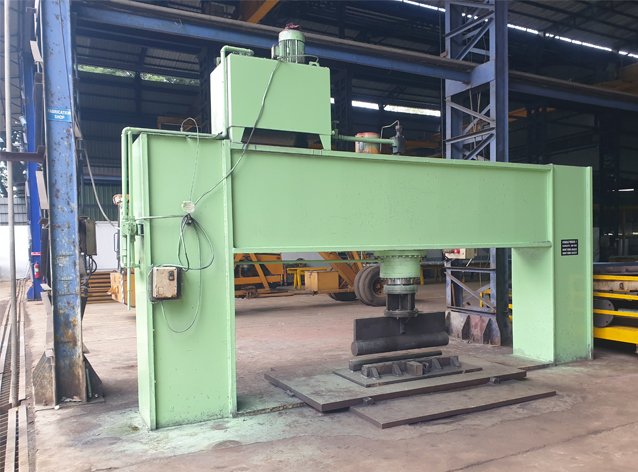
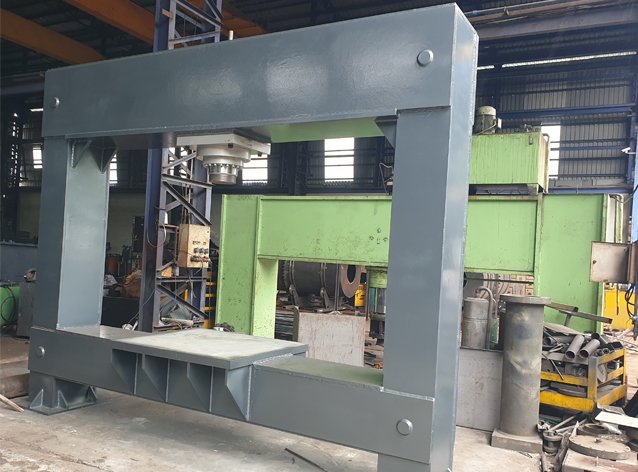
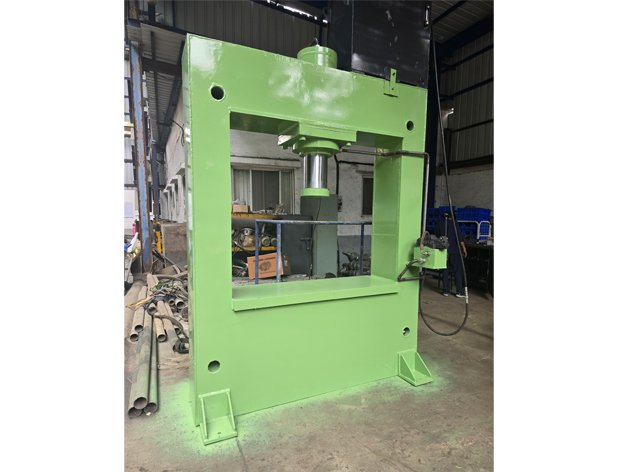
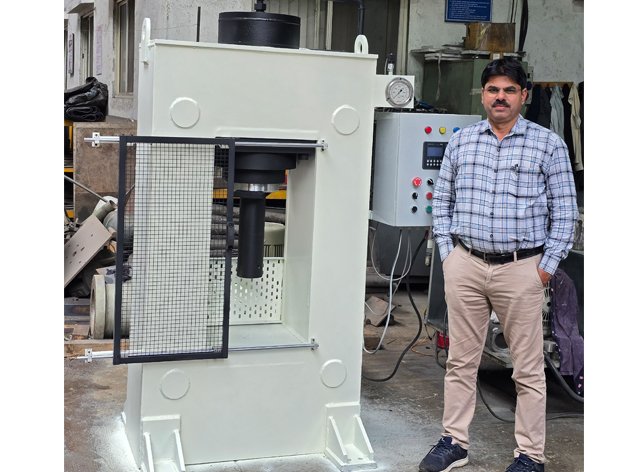
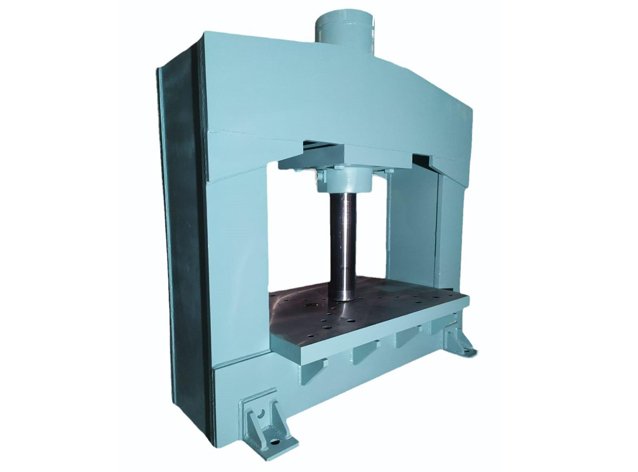
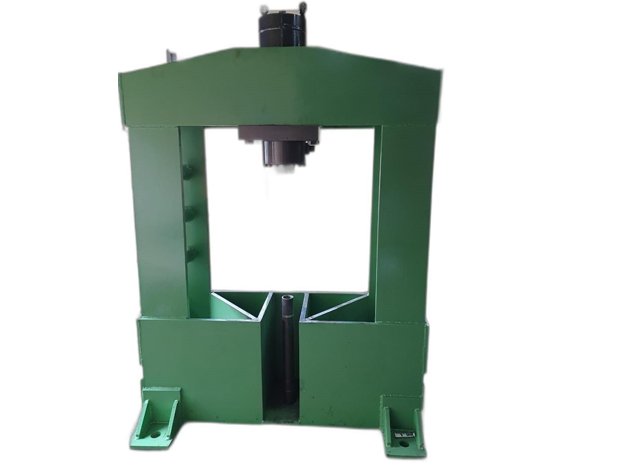
A Hydraulic Press Machine uses pressurized Hydraulic fluid to generate controlled linear force through one or more Hydraulic cylinders, giving industrial customers a machine that can press, form, bend, straighten, punch, assemble, compress and mould components with adjustable pressure and repeatable operation. Desire Hydraulics manufactures Hydraulic Press Machines in-house at MIDC Bhosari, Pune, Maharashtra, for customers across metalworking, automotive, fabrication, engineering, rubber, plastic and composite manufacturing.
The right Hydraulic Press Machine depends on the required pressing force, working area, stroke length, daylight, component dimensions, material, production volume, operating speed, tooling and automation. Because the frame, Hydraulic cylinder, power pack and controls are all built on our own floor, we can configure a Four Column Hydraulic Press Machine, H-Frame Hydraulic Press Machine, C-Frame Hydraulic Press Machine, Hydraulic Workshop Press Machine, Hydraulic Deep Drawing Press Machine, Hydraulic Baling Press Machine, Hydraulic Straightening Press Machine, Hydraulic Forging Press Machine, Hydraulic Rubber Moulding Press Machine, Hydraulic Punching Press Machine or a Special Customized Hydraulic Press Machine around the operation rather than fitting your job to a fixed catalogue frame.
Frames, cylinders, power packs and control panels are fabricated, assembled and tested at MIDC Bhosari before a machine is cleared for dispatch — the same in-house approach behind the 5,000+ hydraulic machines we've delivered to customers across Pune, Nashik, Aurangabad, Gujarat, Bangalore, Kerala, Maharashtra, India and the UAE.
A Hydraulic Press Machine is an industrial machine that uses Hydraulic pressure to generate mechanical force for pressing, forming or compressing a workpiece. The fundamental principle is based on transmitting force through a pressurized fluid: a Hydraulic pump supplies fluid to the Hydraulic circuit, and control valves direct the fluid toward the Hydraulic cylinder, where pressure acting on the piston creates linear force that is transferred to the moving platen, ram or tooling.
A simple way to understand the system is the flow of force through it — from the Hydraulic pump, through pressurized fluid and a control valve, into the Hydraulic cylinder, and on to the ram or platen that presses the workpiece. The machine can be designed to control pressure, speed, stroke and movement according to the application, making Hydraulic Press technology suitable for manufacturing operations where mechanical force needs to be applied consistently and controllably.
Hydraulic power systems are particularly useful where substantial controlled linear force is required, and engineering education resources describe fluid-power systems generally as systems in which pressurized fluid acts on a cylinder or motor to perform useful work, with a cylinder producing linear motion.
The working cycle of a Hydraulic Press Machine can vary according to its design, but the basic process consists of the following stages.
An electric motor drives the Hydraulic pump, which draws Hydraulic oil from the reservoir and supplies pressurized fluid to the Hydraulic circuit. The pump provides fluid flow, while system pressure develops in response to the resistance of the load and the control system.
The pressurized Hydraulic oil passes through the machine's valves and control components. Directional control valves determine where the fluid flows, pressure-control components help manage system pressure, and flow-control arrangements can regulate actuator speed.
When Hydraulic fluid enters the appropriate side of the cylinder, the piston moves, and the piston rod transfers this linear movement to the ram or moving platen. The cylinder can be positioned above, below or elsewhere depending on the machine design.
The ram moves toward the workpiece and the tooling applies force, carrying out compression, bending, forming, drawing, punching, straightening, assembly, moulding, press fitting, cutting or compaction depending on the tooling fitted.
The operator or control system regulates pressing pressure, ram movement and stroke. For advanced applications, position and force may be monitored through sensors and feedback systems, and multi-cylinder applications may need synchronization to keep a moving platen level under load.
After the pressing operation is completed, the Hydraulic circuit changes the direction of fluid flow and the ram returns to its initial position, so the finished component can be removed and the next cycle begins.
A Hydraulic Press is more than a frame and cylinder — its performance depends on the interaction of the mechanical structure, Hydraulic power unit, controls and tooling. The exact configuration depends on the machine type and the customer's requirement.
The Hydraulic power unit generally includes the pump, motor, reservoir, valves and filters required to generate and control Hydraulic power, while the frame, cylinder and bed must be sized to the intended force, working dimensions and application.
Standard on every unit, and adjusted to your process before fabrication begins.
Hydraulic cylinders sized to your tonnage, with controlled movement across the full pressing cycle.
Working area, stroke and daylight built to your tooling and component, not a fixed frame size.
Guarding, interlocks and emergency-stop arrangements suited to the machine design and application.
Straightforward electricals for pressure, stroke and cycle control — PLC-based automation on request.
Die-specific press design and tooling interfaces for the actual pressing, forming or moulding operation.
Every Hydraulic cylinder and power pack is run and checked under load before it leaves our floor.
Every machine is engineered to the application rather than sold on tonnage alone — these ranges reflect what we commonly build; exact figures are confirmed against your component and process.
| Machine type | Four Column Hydraulic Press Machine, H-Frame Hydraulic Press Machine, C-Frame Hydraulic Press Machine, Hydraulic Workshop Press Machine, Hydraulic Deep Drawing Press Machine, Hydraulic Baling Press Machine, Hydraulic Forging Press Machine, Hydraulic Rubber Moulding Press Machine, Hydraulic Punching Press Machine or Customized Hydraulic Press Machine |
|---|---|
| Pressing force | Custom-built to component, tooling and process, as per requirement |
| Working area / bed size | Sized to your die, mould or fixture |
| Stroke & daylight | Sized to your tooling and ejection requirement |
| Cylinder arrangement | Single or multiple Hydraulic cylinders, synchronized where required |
| Control | Panel-mounted controls; PLC-based, semi-automatic or fully automated control available on request |
| Construction | Fabricated steel frame, in-house machining and assembly |
| Testing | Tested under load before dispatch |
Looking for an exact tonnage, bed size or stroke? Share your component drawing and process details and we'll size the machine against it.
Different manufacturing operations require different press configurations. The right configuration depends on required pressing force, working area, stroke length, daylight, component dimensions, material, production volume and the specific operation being performed.
Uses four vertical columns to guide and support the moving platen, giving a large, accessible working area for a broad range of pressing setups.
A rigid frame resembling the letter "H" from the front, commonly used for heavy-duty pressing, workshop applications and general fabrication work.
Also called a gap-frame press, its C-shaped structure gives open access to the working area, convenient for frequent loading and unloading.
Designed for general-purpose pressing and maintenance operations in engineering workshops, fabrication facilities and garages.
Designed specifically for correcting distortion, bending or misalignment in shafts, bars, plates and fabricated structures.
Used for forming sheet metal into deeper shapes such as containers, housings and automotive parts using a punch, die and blank-holder arrangement.
Configurable for different sheet-metal operations — bending, forming and punching — depending on the tooling fitted to the machine.
Uses a Hydraulic actuator to drive a punch through or into a workpiece, producing holes, cut-outs and other shapes.
Uses Hydraulic force to compress recyclable materials, scrap, waste and other suitable materials into compact bales.
Applies controlled Hydraulic force through movement of the press ram to shape suitable metal materials, unlike impact-based forging equipment.
Applies controlled force to close and maintain a mould while rubber compounds undergo the required moulding process.
Engineered around specific dimensions, cylinder arrangement, stroke, controls and tooling when a standard configuration doesn't fit the process.
Hydraulic Press Machines are used across a wide range of manufacturing and industrial sectors. Applications depend on the tooling, material, component design and production requirements.
Component forming, bearing assembly, bush fitting, straightening and moulding processes.
Forming, bending, assembly, straightening, punching and component manufacturing.
Various forming and bending operations depending on tooling and machine configuration.
Specialized presses for compression moulding and other manufacturing processes.
Heavy-duty presses applying substantial controlled force for suitable forging applications.
Baling presses compress recyclable materials for easier storage and transportation.
Bearing removal, shaft straightening, bush replacement and other maintenance operations.
Bearing installation, bush fitting, shaft assembly, gear fitting and component joining.
A wide range of pressing, forming and compaction operations across industrial sectors.
Hydraulic Press technology offers several potential advantages when the design is correctly matched to the application.
Hydraulic systems generate substantial force from a relatively compact actuator arrangement.
The Hydraulic circuit allows the machine's movement and pressing cycle to be controlled according to the application.
Pressure, stroke, speed and cycle settings can be adjusted for different operations, depending on the design.
The same basic press architecture adapts for forming, bending, straightening, punching, assembly and moulding.
Hydraulic technology is well suited to applications requiring significant continuous or controlled force.
Machines can be designed around specific component dimensions and tooling, with PLC controls and automatic cycling available.
Choosing the right Hydraulic Press Machine should begin with the application rather than the machine name.
Desire Hydraulics is based in Pune, Maharashtra, an important industrial and manufacturing region in India. Our Hydraulic Press Machine solutions are built for manufacturers in Pune and surrounding industrial areas, as well as customers across Maharashtra and other parts of India, and for international customers including the UAE.
Machine selection is based on the customer's actual pressing process, component, tooling and production requirements rather than a one-size-fits-all approach, whichever of these regions you're supplying from.
Pressing force, working area, stroke and daylight sized to your actual tooling and component.
Frame fabrication, machining, assembly and testing all done at MIDC Bhosari.
Hydraulic cylinders and power packs are run under load before the machine ships.
Installation guidance and after-sales service across India and the UAE.
Common questions we hear from manufacturers evaluating a Hydraulic Press Machine.